Viridiana, Seven Beauties
Viridiana (5/17/61 Cannes, 3/20/62 New York)
Director Luis Buñuel’s career had evolved from his early start in silent pictures and his 21-minute surrealist mindbend with Salvador Dali, Un Chien Andalou (1929, the flick with the eyeball slicing). He had careened from Spain (his birthplace) to France, the U.S. and Mexico, and made this under the flag of Spain, which submitted it to Cannes, where it won the Palme d’Or, and then was suppressed in its “home” country until 1977.
Viridiana is a novitiate about to take her vows, but the Mother Superior instructs her to make one final visit away from the convent to thank her benefactor uncle (Fernando Rey, formal, rational, increasingly tormented). You know that won’t go well, yet you’re thoroughly surprised at the twists and turns that made this black-and-white picture a Breughel-grade grotesquerie.
The uncle’s bride died in his arms on their wedding night, and — uh oh — she looked just like the fetching, blonde, demure Viridiana. So there’s a start, and not to spoil the story by Buñuel and Julio Alejandro, let’s just say that Viridiana (a convincingly kind, devout Silvia Pinal) has the opportunity to do good works with her rich uncle’s sprawling farm estate, that the project involves a vivid assortment needy peasants, that the uncle’s estranged, illegitimate architect son and his girlfriend soon arrive, and that Buñuel and Alejandro surge toward a long, decadent party scene evoking The Last Supper as Handel’s “Hallelujah Chorus” blasts through the elegant dining room.
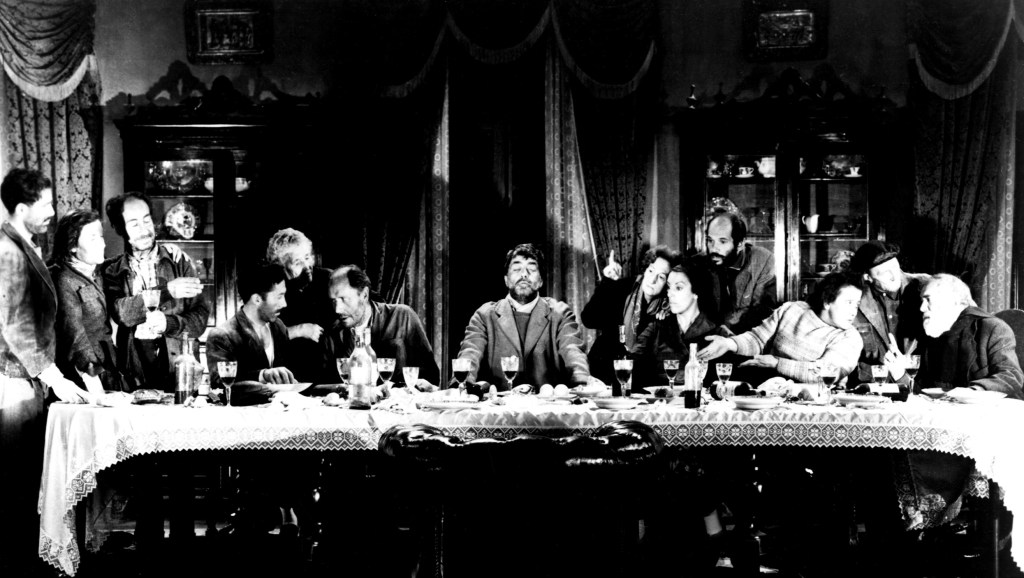
Buñuel keeps his frames pretty crowded with faces and décor, isolating details like the feet of a young girl skipping rope (keep an eye on that rope), or the gaudy blindness or toothlessness of the rowdy peasants, or Viridiana’s crown of thorns — part of her holy gear, and juxtaposed with a spinning rock n’ roll record of singers bopping “Shake your cares away.” He also glides the camera around smoothly, reframing, keeping information coming. It’s a lean, extremely assured 90 minutes.
And it’s fairly angry, working in high contrast between the medievalism of Viridiana’s ascetic style and the slick modernism of the cousin (a dapper, blatantly louche Francisco Rabal). The earthy ending, innocent-looking but rippling with implication, is surprising and sly.
The Vatican wasn’t having it, even if Cannes was. The Palme d’Or-winning picture was deemed “blasphemous” by Rome and banned in Franco’s Spain.
Medievalism is an Ingmar Bergman setting these days, too, not just in The Seventh Seal; see Bergman’s similar religion-sex-violence-primitivism The Virgin Spring (1960).
Seven Beauties (1/22/76)
Love and Anarchy and The Seduction of Mimi in 1974, Swept Away by an Unusual Destiny in the Blue Sea of August in 1975, All Screwed Up made in 1974 but arriving about now: Lina Wertmüller’s American blitz climaxes here, earning Oscar nominations for director, screenplay, foreign language picture (it’s in Italian, with subtitles), and actor for Giancarlo Giannini. Wertmüller’s directing nomination was the first ever for a woman.
Mussolini and Hitler loom over the tale: the Strangelove sardonic blues opening is a fascinating faux dedication (“For those who” this and that, a laundry list of dubious characteristics, like “The ones who never get involved in politics, oh yeah … The ones who even now don’t believe the world is round, oh yeah, oh yeah”), set against a fusillade of Führer/Il Duce demagoguery and WWII carnage. As heated political montages go, set this near the unsettling Americana indoctrination video in Alan Pakula’s 1974 The Parallax View.
Giannini is yet again a Wertmüller fool. Here he’s Pasqualino, nicknamed Seven Beauties, a dandy with seven sisters, a small-time thug whose saga is crosscut between his incarceration in a Nazi concentration camp and how he got there. It’s a journey of dumb pride, with cowardice and complicity sharply illustrated near the beginning, as Pasqualino and a fellow soldier on the run witness citizens being executed.
Lost in a forest, the pal loathes his inaction. But Pasqualino accepts it: “What could we do?”
That attitude keeps Pasqualino alive, but the mantra grows horribly grubby. He’s stupid. Stupidity is viewed a handmaiden to inhumanity. (Hmm.)
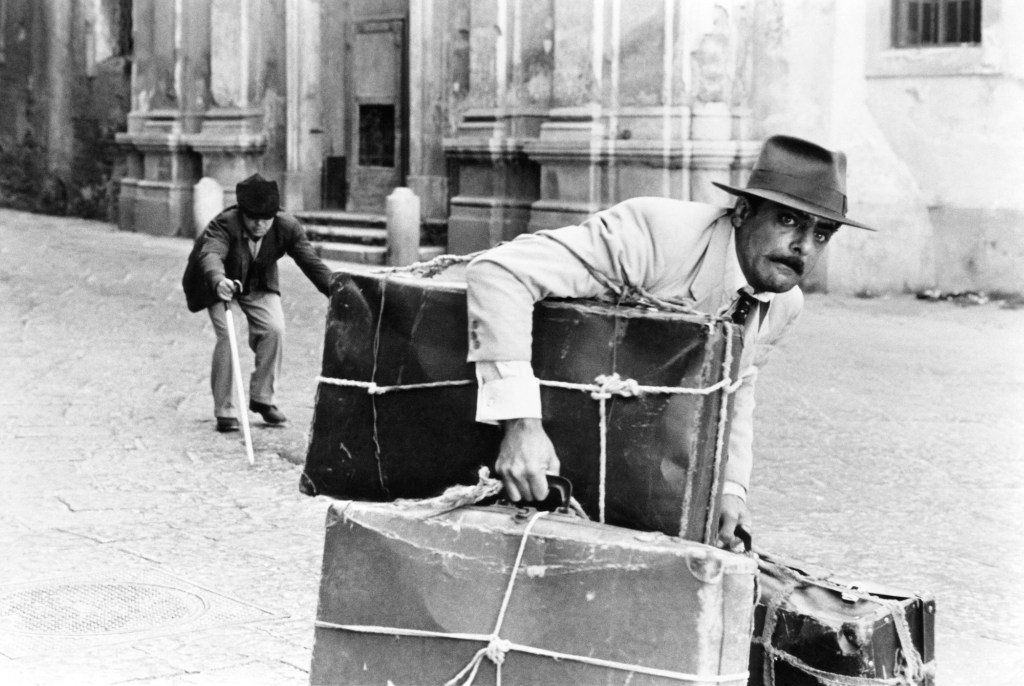
His back story finds him arrested after he proudly slays the defiler of one of his sisters (an honor killing). He cuts up the body and mails away the parts, but is caught anyway. In a dialogue with a political prisoner, he insists he is “bored” by politics, yet inanely states that he likes Mussolini. The dope is baffled to be rebuffed by facts, and by the critique of know-nothings embracing blowhard strongmen: “Now we imagine we’re strong and hide the disease.” (Mio Dio!)
Raised by his mama to fancy himself as a ladies’ man — like the dancer-choreographer Bob Fosse, it seems Pasqualino grew up in a character-warping burlesque setting — Pasqualino tries to charm his way into the sexual graces of the prison matron played as a bulky, small-eyed monster by Shirley Stoler. Wertmüller films Stoler from below, in menacing light, as the worm Giannini flails ineffectually; as always, Wertmüller works broadly theatrically as much as cinematically. Enrico Job’s production design, especially the stark, aestheticized formality of the concentration camp, a vast dim warehouse of straight lines, hung bodies and bowed heads, drew criticism from the likes of Bruno Bettelheim. (Job and Wertmüller were married from 1965 until his death in 2008.)
Likewise, the sloppy dubbing, endemic in this flurry of Wertmüller movies, is hardest to take in this starkest of her pictures. Looping in the dialogue after the fact displays a disinterest in the realistic power of cinema acting, the truth of nuanced language. (This dubbing is like a punch in the ear.) So, too, Wertmüller’s tight closeups, chin to forehead again and again, or tighter, mouth to eyebrows, so relentless as to be almost boring, especially on such an uninteresting, thoughtless face.
Not that Giannini is incapable of imbuing his Keaton Stone Face with meaning. At one point, smoking a cigarette in prison, those shifty eyes express mild pleasure, like a reptile in the sun. That’s the primitive goal here: dramatizing that fundamental, destructive Life Force as the plot cruises toward its version of a Sophie’s Choice, the sadistic options Nazis foisted on victims to make them complicit. (William Styron’s book was a few years away, and Pasqualino is no hapless Sophie; one of his crimes is raping a mental patient strapped to her bed.) Fernando Rey plays a raisonneur figure who resists, spectacularly, but Pasqualino is what he has been all along: idiotic, gullible, vain, a killer and a whore if it means he can eat, not bright, alert or soulful enough to change his conditions.
It’s a critique writ large, as the opening montage declares, so Jerzy Kosinski’s lengthy complaint in the Times seems amiss as he targets the film’s lack of humanity, particularly regarding its lack of insight into the flat and unchanged Giannini character. (Chauncey Gardiner, anyone?) Pauline Kael, thoroughly tired of the Wertmüller craze, compared her unfavorably to Shaw and Brecht, though the more apt comparables were Fellini and Dario Fo. Harder to shake were Molly Haskell’s issues with Wertmüller, reasonably questioning the repeated centrality of Giannini and the repeatedly deformed shapes of women in general.
It’s odd, but not out of step with how awards and popularity often work, that this most acclaimed of Wertmüller’s indisputably impressive, swift mid-1970s wave is not the best of the bunch, even though in many ways it’s the most ambitious. (The controversial battle of the sexes Swept Away was the must-see lightning rod; Love and Anarchy and The Seduction of Mimi were such frisky delights that director Michael Schultz and star Richard Pryor remade Mimi in 1977 as Which Way Is Up?) The devastating, society-wrecking, lyrically named Seven Beauties character — a mental, moral brute — seems spot-on half a century later.
 Nelson Pressley