WUSA, Nashville
WUSA (11/2/70)
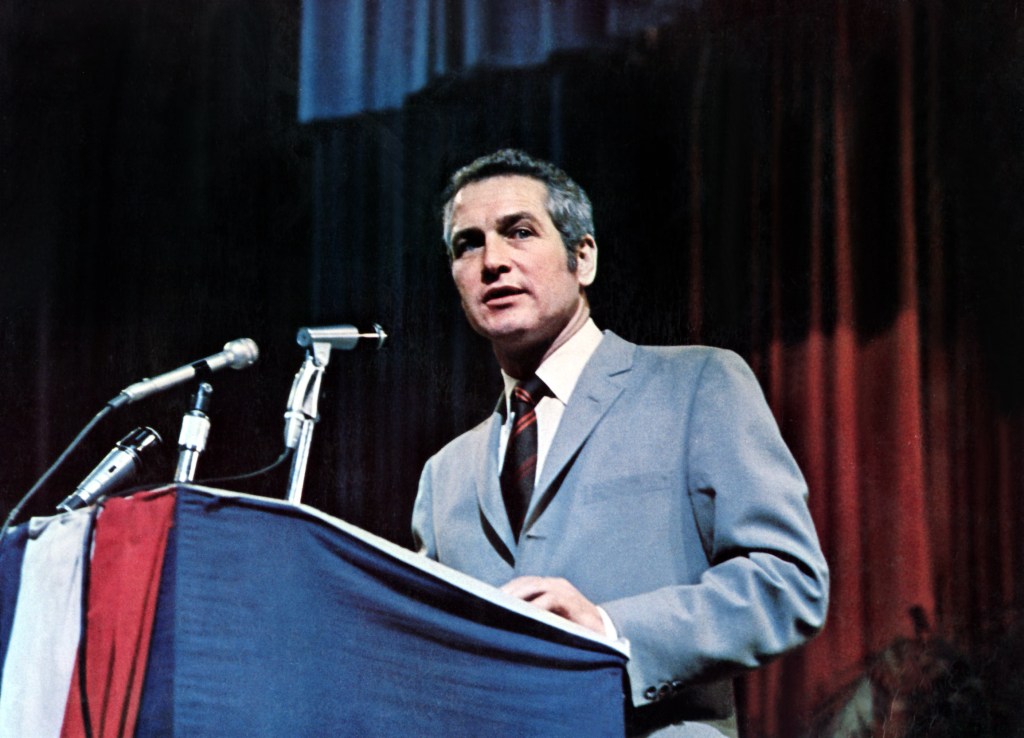
Paul Newman re-teams with Cool Hand Luke director Stuart Rosenberg in a bitter, cynical snapshot of America that Robert Altman would refine in Nashville: regressive southern setting, climactic political rally, messy assassination, prevailing national incoherence.
Drifter/drunk Newman is a nice enough guy to rescue Joanne Woodward’s scar-faced hooker from a local pimp; this is New Orleans, and a dingy, grubby town it is. (The rooming house Newman and Woodward wind up in looks like menacing Barbara Stanwyck’s bordello in Edward Dmytryk’s seamy 1962 A Walk on the Wild Side.) But Newman so aggressively disdains the rest of the world, ranting against everything from commitment to kindness, that he sells his talents to a rabid right-wing radio station run by movement-minded Pat Hingle.
This is an expansion on Newman’s spiteful Brick in Cat on a Hot Tin Roof, only he’s ambulatory, more fully in the wicked world and simultaneously apart from all its mendacity, again thanks to the membrane of booze. One of the pleasures of this tart film is the precision of Newman’s acidity. The golden boy was more than willing to be unlikable on camera, so the sarcasm and insults are ugly. When he winks at you, it’s like a knifing.
Also wonderful is Woodward’s achingly lived-in turn as a fellow drifter reduced to hustling for meals. It tells you how rough her life’s been if she clings to Newman’s forbidding character for real affection and stability, and all of it registers as Woodward commits herself to the push-pull with him. He’s well-read and literate, while she’s earthy and intuitive; already costars in half a dozen movies, and fresh off Newman directing Woodward in Rachel, Rachel (1968, with four Oscar nominations including Best Picture and Actress), the stars sink deeply into these craggy misfits, finding tons of communication between the lines.
Newman produced this from the 1967 debut novel Hall of Mirrors by Robert Stone, with Stone writing the screenplay. As a political film it can seem too general, yet the corrosive outlines reverberate with a vengeance. The right-wing politics of radio station WUSA are mere harbingers of what has actually transpired, hardly the rhetorical flamethrowing explored in Eric Bogosian’s Talk Radio (filmed by Oliver Stone in 1988, with Bogosian playing the shock jock) or the wildly consequential 21st century narrative hoaxes on Fox. But the manipulating, with-us-or-against-us, flag-waving “patriotism” — labeled in this movie as “more extreme” than older versions — is clear enough. Everyone in Newman’s circle questions why he’d abet such a blatantly nefarious broadcaster, and Pat Hingle is evil itself as the station owner. His understated, confidently smug delivery paints American “morality” as a righteous iron fist. The communications empire, he warns, is only growing, paving the way for a new American revolution. Yikes.
Is this figure a caricature? That’s all there is to Hingle, a business kingpin molding mass opinion (and nothing new about that in American narratives). But is “caricature” even a legit critique when real American officials — and their media champions/apologists — act like unbelievable cartoons?
Even when WUSA feels thin or distracted, it gets the patterns right. Laurence Harvey appears early as a fake priest who owes Newman money; he then all but disappears from the film, but his skeevy vibe sets the tone of charlatanism, opportunists, false prophets, grifters. Anthony Perkins is an earnest young liberal so fragile that he stammers, stumbling through a mysterious job that turns out to be a scam that will undermine the city’s welfare program, which of course primarily benefits Black citizens; Moses Gunn is poetic, dapper and thoroughly corrupt as the local Black figurehead in on the fix. Hippies take a hit as Newman hangs with potheads portrayed as careless, and responsible for Woodward’s eventual tragedy, a twist that doesn’t wholly ring true. The story’s odd, and the cynicism’s god-awful broad as the action crests at a white-power rally with Confederate flags and Perkins on a catwalk, situating WUSA somewhere on the troubled line from The Manchurian Candidate (1962) to The Parallax View (1974).
But the arc is surely recognizable, and the theme drummed over and over, especially in the dynamic between Newman and Woodward, is humanity — staying on the right side of that.
Nashville (6/12/75)
In the ’70s it didn’t take much to become a Robert Altman devotee: cackle with counterculture hipness of the military satire M*A*S*H (1970), dig the moody alt-western vibe of McCabe and Mrs. Miller (1971), slink through degenerate L.A. with Elliott Gould’s Philip Marlowe in the neo-noir The Long Goodbye (1973). By 1975, Altman was such a visionary and Nashville was anticipated as such a boundary-pushing wonder that influential New Yorker critic Pauline Kael reviewed the picture (a rave) in February, before the edit was done, and way ahead of its June release.
But it was possible for a M*A*S*H/McCabe/Goodbye buff to be slightly less hooked. This kaleidoscopic Americana, arriving on the cusp of the Bicentennial and barely a month after the fall of Saigon, was rightly lauded for its near-plotless narrative style, gliding among a grand hotel’s worth of characters. Yet — here we go again — it wouldn’t be at all amiss to call the figures in this deliberately political canvas caricatures.
Altman, screenwriter Joan Tewkesbury and the improvising actors (some of whom wrote their own songs) condescend to most of the American narcissists on parade; indisputably, this is satire. Henry Gibson is a dour country crooner in major Elvis drag, cracking a tyrannical whip in the recording studio as he sings the idiotically patriotic refrains “Keep A-Goin’” and “We must be doing something right/To last 200 years.” Keith Carradine is his foil, a dashing young rock-inflected star splintering away from a popular folk trio, a womanizer who beds conquests while listening to his own music on tapes. Ronee Blakley is beloved icon Barbara Jean, singing nostalgic tunes of family and love, of pluck and heartbreak. Geraldine Chaplin is a documentarian so out of it that at the climactic assassination — apparently an Altman add-on as the project germinated while he absorbed the Watergate hearings — she floats through the crowd asking, “Can somebody tell me what happened?” Gwen Welles is a would-be singer with so little self-awareness that she strides into the spotlight, warbles badly, suffers boos, then strips on demand for the male chauvinist pig crowd of political donors (this strip act is a fundraiser) — and she still thinks she’s going to make it as a vocalist. (Welles’s woeful “pitchiness” is expert: if a turtle could sing, this would be it.) Barbara Harris is another striving crooner; she’s the one who leads the crowd in an undaunted singalong after the shooting, to Carradine’s catchy, evasive “You may say that I ain’t free/But it don’t worry me.”
There’s more, more more, with Shelly Duvall and Jeff Goldblum as indelible peripheral flakes, Ned Beatty as a political operator, Lily Tomlin as his gospel-singing wife, Michael Murphy as another political organizer, an unseen political candidate broadcasting policies from inside a roving van, Karen Black as a singer who foolishly insults the real Julie Christie, Cristina Raines as a folk singer in a romantic triangle with her trio … The scenario keeps two dozen figures in view across five days, and this list doesn’t even include the character who emerges as a shooter at the climactic political rally/concert. It’s a very bleak comic sketch of the country as stupefying, self-absorbed know-nothings.
At 160 minutes it strings together beautifully, which is a testament to the collaborative medium that moviemaking can be. Justin Wyatt’s 2026 book Nashville: An Archival Exploration makes an argument for the centrality of Tewkesbury’s screenplay, even with Altman riffing and cast members writing songs that range from insipid (Gibson’s flag-wavers) to brilliant (Blakely’s yearning, determined numbers, Carradine’s mesmerizing “I’m Easy” and exactingly pointed “It Don’t Worry Me”). And the movie rides its copious music wonderfully: Blakley’s obviously the real deal, as are all the bands; “I’m Easy” stops the overlapping chatter of the characteristically bustling Altman joint in its tracks; and the movie lingers on the “It Don’t Worry Me” assassination coda well after the credits are done. The performances are blissfully casual, even Chaplin’s flamboyant turn as the ninny British journalist bent on poeticizing the American experience.
Again, like WUSA, any weaknesses (and Nashville partisans may reasonably admit to none) look stronger with time as the country’s actual strengths weaken, pretty much as warned. There’s a void of seriousness, a cavalcade of kook. Celebrity assassination? Keep a-goin’. Election-denying insurrection? It don’t worry me.

