American Dreamer, The Murder of Fred Hampton
The American Dreamer (4/22/71)
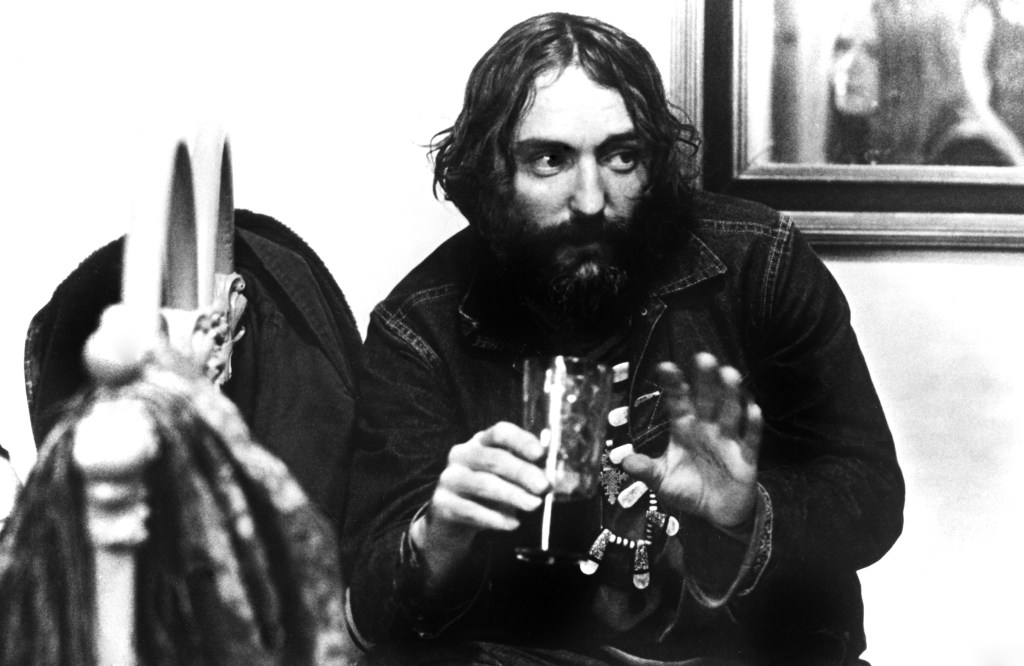
Lawrence Schiller and L.M. Kit Carson toted their cameras into Dennis Hopper’s Taos, New Mexico “Mud Palace” hangout as Hopper edited The Last Movie and refined the art of being Dennis Hopper, Easy Rider shaman and counterculture lost boy. (Hopper’s face often suggests worry because he can’t find James Dean.)
As one would expect in a documentary about an out-there auteur, proclamations fly regarding art, and an indignant Hopper waxes righteously about the commercial strictures of pictures. Easy Rider was a dark horse smash; what, the interlocutors wonder, if his follow-up, The Last Movie — the 1971 “acid western” directed by, co-written by, and starring Hopper as a movie stuntman in a Peruvian village where the pretend stuff grows too real — is not accepted?
“I can become Orson Welles, poor bastard,” Hopper says, sitting in the New Mexico desert; Welles was grappling with filming/financing his own philosophical opus, The Other Side of the Wind, which wouldn’t be released until 2018, more than three decades after his death. “If they can’t build up Orson Welles making a movie for half a million dollars and show it in the universities, then fuck ‘em. And fuck the universities, fuck everyone, man, because there’s no audience … If there isn’t an audience for Orson Welles and half a million dollars in the universities and for the people in this country, then why are we making movies?”
Swinging to Easy Rider, Hopper says in his mind it’s the same corruption: the dope sale and the corporate sales. The redneck dudes who shoot the riders and the aimless riders themselves are more or less the same, all entwined in American venality.
Initially Hopper registers as an eccentric but dedicated artist, a bearded dude in denim, beer and cigarette rarely out of view, articulate about a director needing a photographer’s eye, an understanding of acting, and a feel for story; his comment about finding editing the most boring part of moviemaking is logically argued. But increasingly it’s TMI as the blatantly leering documentarians watch everything, including an explicit three way (Hopper’s ideation of free love, candidly sharing his fantasies) and a long encounter session with a dozen or so women, everyone getting high, bantering, sharing, massaging, and with Hopper eventually baring his ass-soul for the women.
“Here we are again in the adventure palace,” Hopper wisecracks for the ever-present cameras.
It’s easy to mock the excessive Dennis Hopper, the one who, as this picture searches for itself, ferments and indulges and waxes on, you know, women, man, lots of women, or his jailhouse visit with Manson. The stars in his eyes fuse and whirl, he laughs that nervous manic one-note cackle, and the brain seems soaked and charred. That feels like caricature, yet this artifact shows that in no small part it’s really what he was like. And as hedonistic drifters bliss out on the den floor, strumming guitars, getting high, stripping down, it’s a shot of what some of the dropout artist/alt Hollywood scene was like, too.
The Murder of Fred Hampton (10/5/71)
Mesmerizing documentary on two levels: first, as the Chicago collective The Film Group, which captured plenty of fractious footage during the 1968 riots around the Democratic National Convention, follows Black Panther leader Fred Hampton, a charismatic, focused speaker and leader even as a very young man, and second, tracking the controversy as the Chicago police storm Hampton’s apartment, murder the 21 year old, and concoct a cover story that quickly falls apart.
The black and white footage is grainy and the style is no-frills, with the camera scanning back and forth during, say, a rally in a vast church full of activists, or a small meeting between Hampton — chairman of the Illinois chapter of the Panthers — and a potential ally group, or in a community center where Panthers serve free breakfast to kids, or through a free health clinic organized by Panthers. The simplicity means you get to watch Hampton at length, and, as with Bob Lee in the Film Group’s more tedious American Revolution 2 (1969), you lean in to hear his ideas. They include thinking beyond race, understanding that class is the bigger issue, promoting socialism (see the free breakfasts and health clinics), even embracing communism, and with “motherfuckers” flying, declaring that force by “pigs” will be met with armed resistance (aka “blowing their motherfucking brains out”).
Directed by Howard Alk, with Alk and producer Mike Gray (the original China Syndrome screenwriter) behind the cameras; they got into Hampton’s apartment shortly after the shooting, filming the premises as evidence. The police are profoundly unconvincing in their descriptions of a twelve minute shootout [I’m re-reading this in January 2026, with Minneapolis and the country outraged by the blatant government lies after Donald Trump’s assault-happy ICE agents have killed two peaceful observer-resisters in three weeks [[and posting 5/21/26, with Trump’s DOJ trying to heist the hocus-pocus figure of $1.776 billion for payouts to Jan. 6, 2021 insurrectionists and other cronies claiming harm from federal “weaponization”]], and Cook County state’s attorney Edward Hanrahan sounds particularly bogus as reporters grill him about inconsistencies.
This 88 minute documentary can’t hold up as the definitive word on the complicated case, but its immediacy is undeniable. It’s a wonder that it took almost fifty years for the movies to get around to Hampton as a subject, which finally happened in 2019 with Judas and the Black Messiah. Daniel Kaluuya’s fiery, heroic, Supporting Actor Oscar-winning turn as Hampton hardly exaggerates on what we see here of the real thing.
 Nelson Pressley