Summertree, Vietnam! Vietnam!
Summertree (6/17/71)
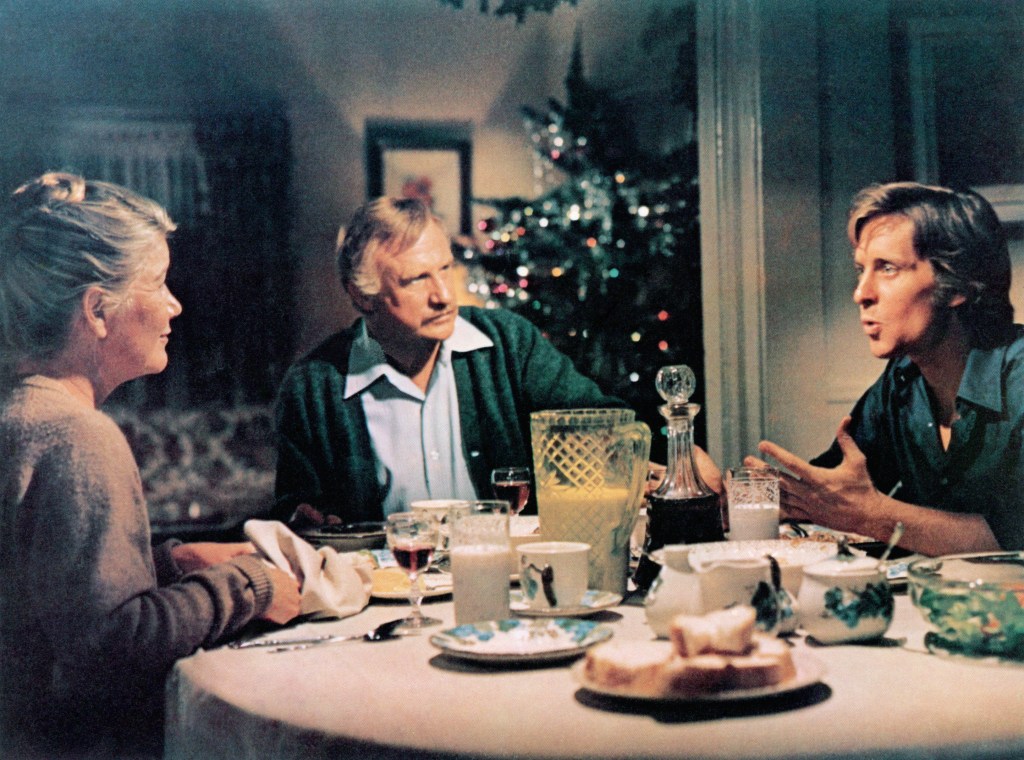
An understated antiwar story from a 1967 Pulitzer-nominated play by Ron Cowen, who would go on to develop TV’s An Early Frost and Queer as Folk. The screenplay observes Jerry (an upbeat, alive Michael Douglas, Cowen’s colleague at the O’Neill National Playwrights Conference in 1967, where he first played this role) strumming guitar, dropping out of college to audition for the music conservatory, connecting with nurse Brenda Vaccaro (sunny, grounded), maintaining a contentious yet polite relationship with parents Jack Warden and Barbara bel Geddes. When the conservatory says they love his talent but can’t admit him as a transfer, he’s suddenly vulnerable to the draft. Innocence turns to dread as the story shows how hard it is to get out of it.
Cowen was 22 when Summertree went through the write/rewrite/produce/critique process at the O’Neill, and while Douglas was replaced for the off-Broadway staging by David Birney, and Douglas’s dad Kirk then bought the movie rights, Cowen’s 1972 New York Times reminiscence on the O’Neill premiere betrays no sour grapes. Yet the screenplay, credited to Edward Hume and Stephen Yafa, plainly made changes, including a new subplot with Jerry signing on as a Big Brother to Marvis, a young Black kid whose older brother is already in Vietnam, keeping in view problems of who serves and who swerves out of harm’s way. As Douglas searches in the schoolyard for the kid (Kirk Calloway, precociously swearing and giving Douglas the side-eye), the movie even indulges in a Spartacus joke, with all the Black kids looking at the White man and mischievously blurting, “I’m not Marvis!” “I’m not Marvis!”
The picture is directed by Anthony Newley, a British-born ’60s showbiz force as a Vegas-grade crooner, songwriter (“What Kind of Fool Am I?”, “Goldfinger”) and a theater and film composer (Stop the World — I Want to Get Off, Willy Wonka and the Chocolate Factory). Odd choice, and he mainly stays out of the way of the actors, taking careful looks at Douglas and Vaccaro playfully falling in love. It’s the picture’s weakness; you wonder what it might have been like in the hands of a Coppola, who had just made the supple character study The Rain People, or ’70s shaman Hal Ashby, whose directorial debut The Landlord opened mere months before this. Screens have already been shredded for several years by riot/protest/Generation Gap movies, and this would barely cut it at a fest with, say, Getting Straight, The Strawberry Statement (similarly penned by a young man in the thick of it — James Kunen was 20), The Revolutionary, Joe (with a climactic tragedy nearly identical to Summertree’s, though that father, played by Peter Boyle, is far more virulently reactionary), M*A*S*H, Catch-22, Soldier Blue, Zabriskie Point, and Woodstock. And that’s just choosing among 1970 films implicitly or explicitly in the same topical ballpark.
Still, this Douglas kid holds the screen, and as he weighs his choices with pals Rob Reiner cracking jokes and Teri Garr driftily listening in, even his soft disagreements with Warden (whose light touch with paternal pride and traditional expectations, like bel Geddes’s quiet steel, are right in Cowen’s congenial key) carry weight. Father and son don’t explode in argument, but the war plays out on the living room TV as the stakes escalate. And credit where due: Newley films the brief appearance of Vaccaro’s husband, a soldier back from Vietnam, with terrifying stillness. Bill Vint is almost all menace and aura in the role, barely speaking, practically reeking of napalm.
Of course Marvis’s brother is reported dead in Vietnam. Of course the soulful, gentle Douglas character decides Canada is the only option. The plot’s final twist may have seemed pat to contemporary audiences, and the earnest drama winds up in tune with the radical Hair: music can’t save our lamb, and off he goes. Yet it lands like a deep, stupid betrayal — familial, and national.
Watch with Joe (Susan Sarandon is the daughter), or with Elliott Gould as a Vietnam vet back on campus and Candice Bergen as his protestor girlfriend in Getting Straight; watch with Haskell Wexler’s in-the-thick-of-the-’68-Chicago-protests Medium Cool, or with Michelangelo Antonioni’s head-trip view of tragically estranged American youth, Zabriskie Point.
Vietnam! Vietnam!
An unreleased documentary production of the U.S. Information Agency, with John Ford as executive producer and Charlton Heston narrating this two-part, 52 minute defense of the war effort. Part One, “The People and the War,” racks focus from long views of town and country scenes to closeups of barbed wire, then surveys the ordinariness of citizens working fields, eating rice.
“But now,” Heston intones, there are “intruders”: refugees from the unhappy, invading, communist North, perpetrators, along with the Viet Cong, of carnage and atrocities shown in footage of amputees and their prosthetics, in photos and film of bodies burned and bloated and left rotting in the streets or in the weeds. The North’s indiscriminate massacres are followed by callous mass graves; the footage here is of skulls and bones, and of mourning in streets, while, in the streets of North Vietnam, victory rallies celebrate the aggression.
Continuing the narrative of the war from its beginning to the end of the ’60s (footage of JFK addresses are frequently inserted to illustrate American policy decisions), the South Vietnamese initiate flight missions to discover enemy weapons, and the U.S. and other countries begin to help defend South Vietnam. Depictions of the North’s brutality accrue (we see horrifically emaciated prisoners of the Viet Cong), as do images of the seemingly benign, practically saintly efforts of the U.S. military, with soldiers seen washing the feet of wounded Vietnamese.
Then come the talking heads of the American military wives lodging complaints against the North Vietnamese and the U.S. antiwar movement, conflating them as one and the same. The camera zooms toward the young son on Sybil Stockdale’s lap as she reads from her letter to Sen. Fulbright “expressing the idea that the most vociferous critics of the war have very probably lengthened the war and thus had a detrimental effect on the possibility of release for the prisoners. At that time, you refused to see me on the grounds that my idea was so preposterous — and that was his phrase — that visiting with me would serve no purpose.”
Hanoi is accused of cruel treatment of prisoners, per testimony of wives and returning prisoners, and then the project transitions to Part Two, “The Debate,” toggling between news footage of public figures weighing in on both sides, from Dr. Benjamin Spock (against) to California governor Ronald Reagan (against simply bringing home the troops because “the price for that kind of peace could be a thousand years of darkness”). Veterans speak for “freedom,” and discount protestors’ views because they “haven’t been to Vietnam,” “don’t know anything about it.” Students and elected officials opine on whether the war is just, is winnable, is affordable, is a mandatory stand against Communism.
The ending again sweeps across the decade with statements from Ike, JFK, LBJ and, finally, Nixon, addressing North Vietnamese aggression, communist oppressions, the principle of American loyalty to international allies, and therefore staying the course, with a wild jump cut from Nixon’s platitude to a cheering crowd of diplomats — but seemingly a different crowd than the one he was addressing, or at the very least, a jarringly different moment.
“Without defense,” Heston sums up, speaking of the South Vietnamese, “their families and country would live no more.”
In 1985, Heston would narrate “Television’s Vietnam: The Real Story,” produced by Reed Irvine’s conservative Accuracy in Media and aired on PBS as a “rebuttal,” in the words of the New York Times, to PBS’s own 13 part “Vietnam: A Television History” in 1983. See John Corry, “‘Television’s Vietnam: The Real Story,’ On PBS,” The New York Times, June 27, 1985; see also Fox Butterfield, “A Critique on PBS of Vietnam Series Sets Off a Dispute,” New York Times, June 13, 1985.
From the June 10, 1971 New York Times, Tad Szulc, “$250,000 U.S.I.A. Movie on Vietnam, 3 Years in the Making, Being Shelved”:
“It’s a dead duck and it will stay in the can,” a source in the agency said in response to inquiries whether the film, directed by John Ford and now virtually completed, would ever be released.
It was reliably reported that the head of the agency, Frank J. Shakespeare Jr., had concluded that the changing military and political situation in Vietnam, as well as domestic political considerations, now raised doubts on the film’s value as convincing and productive propaganda.
In the absence of a decision by Mr. Shakespeare that the film should be distributed, the sources said “Vietnam, Vietnam!” will simply be allowed to “fade away.”
Only a few months ago, the agency’s motion picture and television division sent out circulars to posts abroad saying that the film would soon be available for distribution to foreign television networks and stations or for cinema showings.
The agency has refused to show the film to newsmen pending completion and a decision by Mr. Shakespeare to authorize its distribution abroad. But it was understood that “Vietnam, Vietnam!” sought to portray the United States Government’s side in the war controversy.
The act of Congress that set up the U.S.I.A. specifically barred domestic presentation of the agency’s films.

 Nelson Pressley