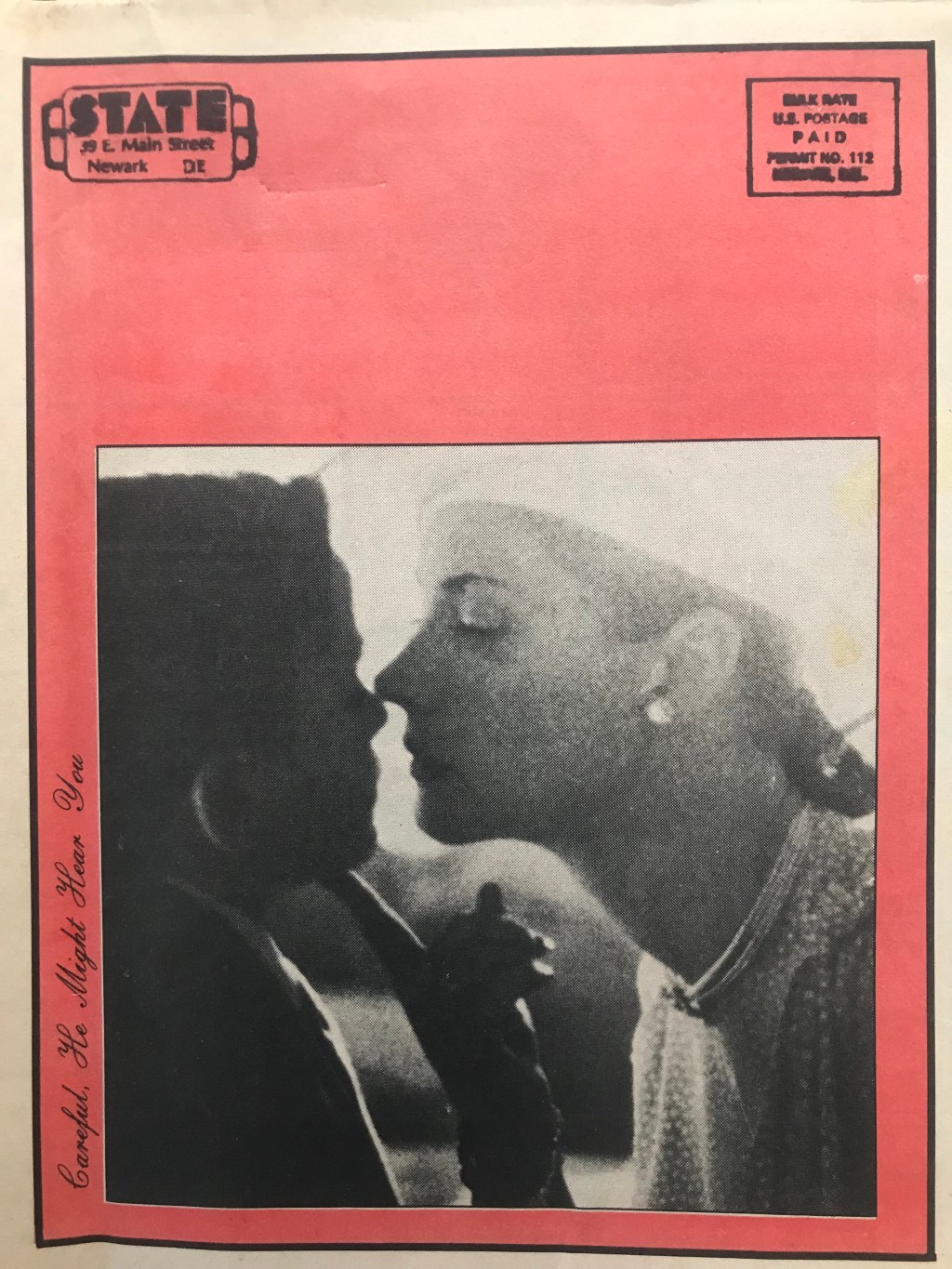
The State Theatre/One Sings, The Other Doesn’t/Peppermint Soda
The State Theatre
So this is resolutely not a nostalgic project … and inevitably, it is. It revives college nights at the State Theatre, an art house of double features, midnight cult hits and the odd rock or blues concert.
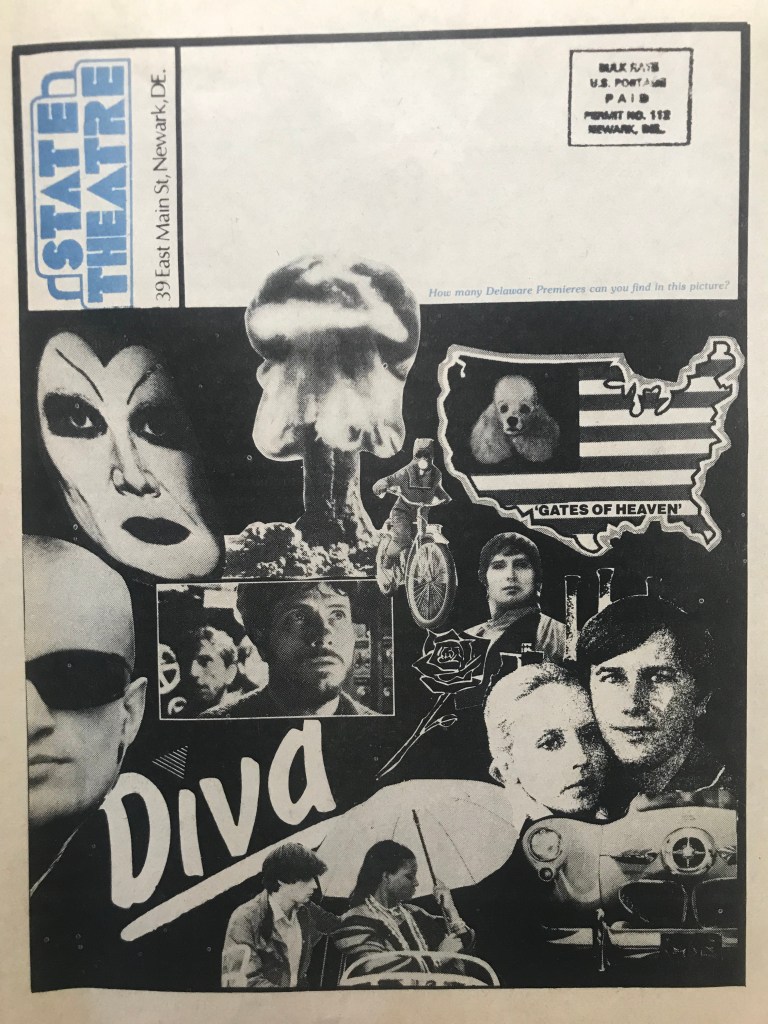
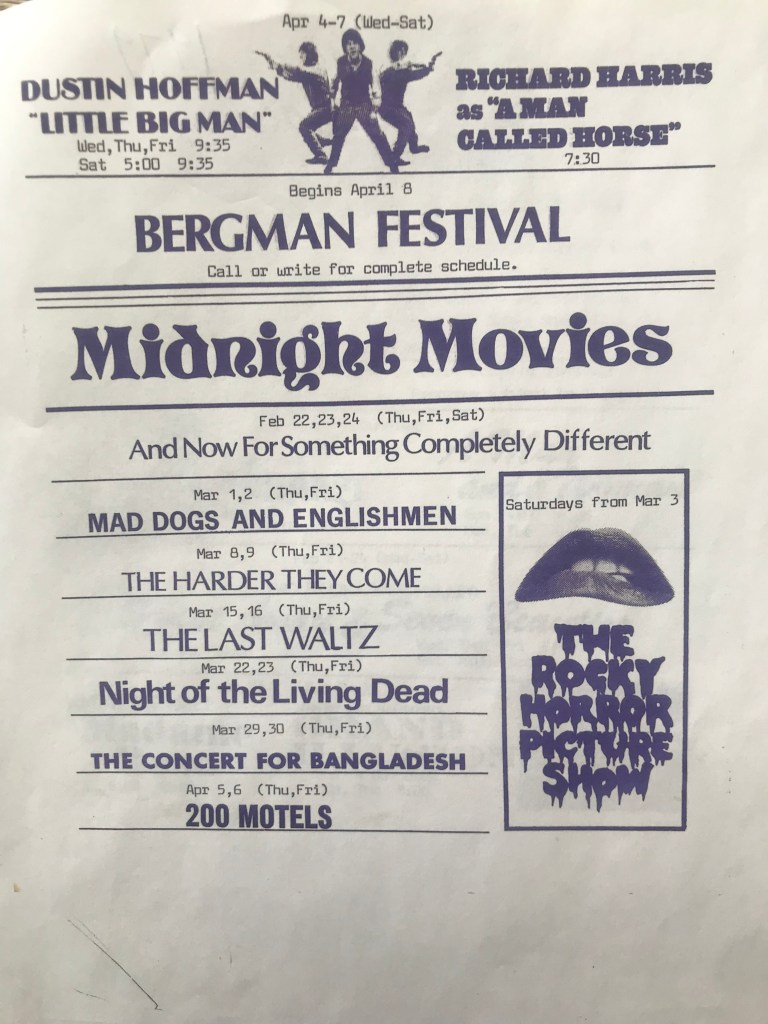
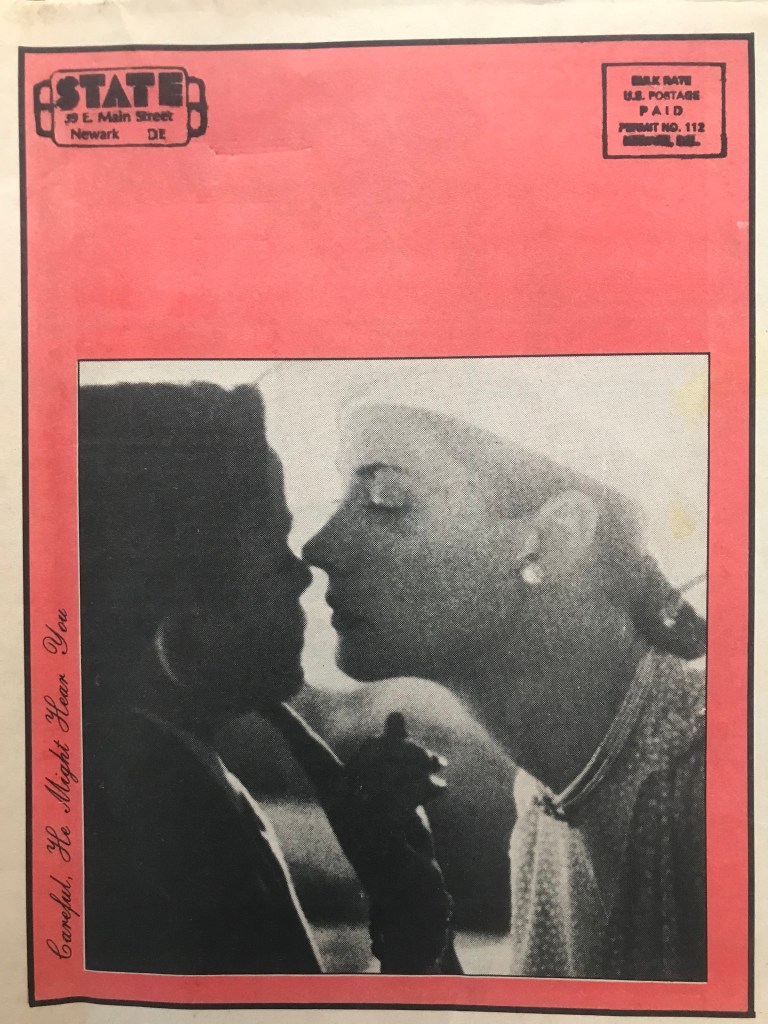
When I first pondered a Fonda book back in 2007, my impulse was to check in with The State’s shambolic overlord, Barry Solan. In February 1979, Solan had re-opened the 1929 vaudeville house, conveniently located at the end of Newark, Delaware’s one-way, five-block Main Street as it cut across the University of Delaware’s campus. (As a student I had hoped to work there. No soap. Everyone wanted to work there.) His programming followed what he called a “hardcore art policy,” which meant the offbeat and underground, concert movies and international films, The Rocky Horror Picture Show Saturday midnights and Bergman’s The Magic Flute at Christmas.
Concerts were rare but choice. Local boy George Thorogood played The State several times. The Nighthawks opened for Rick Danko. “I always say the Muddy Waters concert was the best $3500 I ever lost,” Solan told me.
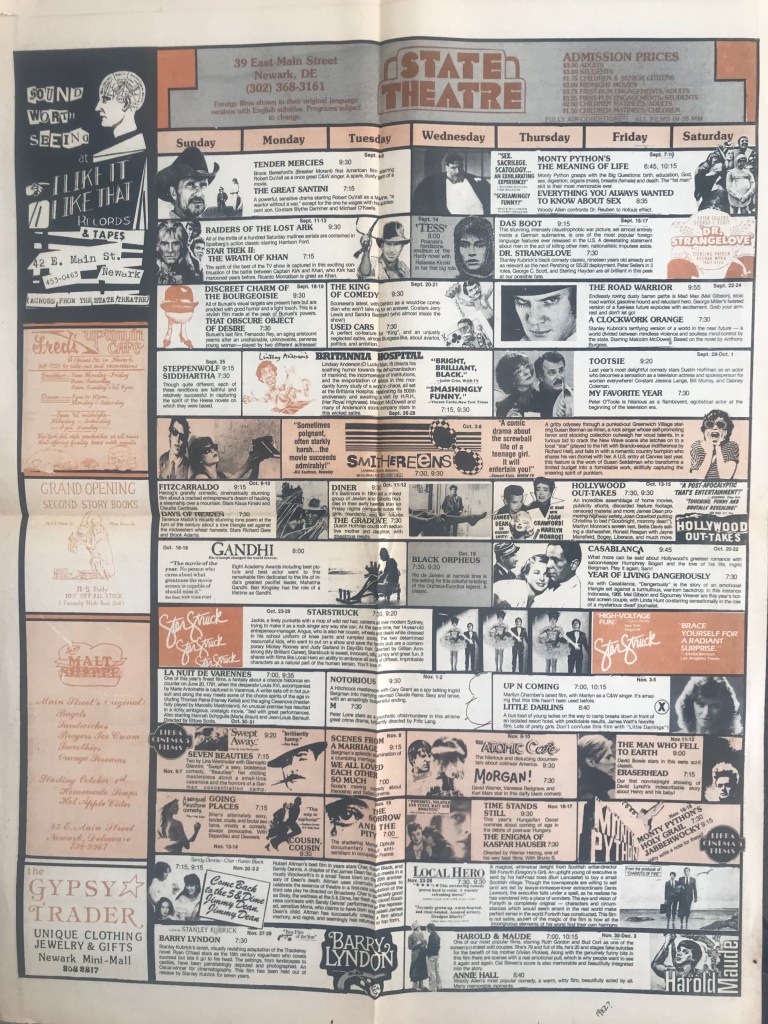
The programming turned over every few days; when the quarterly schedule came out you taped it to the wall and planned accordingly. Barry’s mother baked jumbo chocolate chip cookies, the hit of the concession stand. You could smoke inside, so imagine slouching in the largely empty balcony, watching Bowie in The Man Who Fell to Earth, exhaling Kool plumes into the projected light. Imagine packed interactive Rocky Horror screenings, rice tossed, toast thrown, and a motorcycle revving down the aisle as Eddie arrives on screen singing “Hot Patootie — Bless My Soul.” Imagine meeting friends in the lobby between pictures and getting the news that Reagan was obliterating Carter.
Revisiting all this didn’t help much directly with the book, it turns out. The State is long gone, demolished for a bland little shopping galleria. This notebook’s twinbill-dusted taste, though, comes straight from The State.
One Sings, The Other Doesn’t (9/23/77)
Gentle countercultural gem from France’s Agnès Varda, a beautifully thought-through feminist saga of two women who bond young in 1962 and navigate loves, losses and frustrations well into the 1970s. Abortion seals their kinship: in ’62, Suzanne is 22, living with a married photographer who can’t get a divorce and can’t sell his work, and she’s pregnant with a third child she can’t reasonably raise, while Pauline is 17 and on the edge of finishing school, but more interested in singing. Pauline, an upbeat and prickly redhead as played by Valerie Mairesse, lies to her parents and gets the illicit abortion money for Therese Liotard’s impoverished, deeply melancholy Suzanne.
Hotheaded Pauline moves out of her parents’ house, drops out of school and changes her name to Pomme (Apple), while Suzanne has to regroup after tragedy befalls her husband, whose sullen photo studies of women prove to be a window into his troubled soul. From there the friends’ paths diverge, yet they stay in touch after running into each other at the 1972 Marie-Claire Chevalier abortion rights trial. Apple is a hippie folk singer and would-be dancer-choreographer in love with a handsome, seemingly progressive Iranian economist she met in Amsterdam (though just wait ‘til they live for a while in the patriarchal society of Iran), while Suzanne survived emotionally harsh treatment living on her disapproving parents’ grubby farm and now runs a family planning center on the Mediterranean.
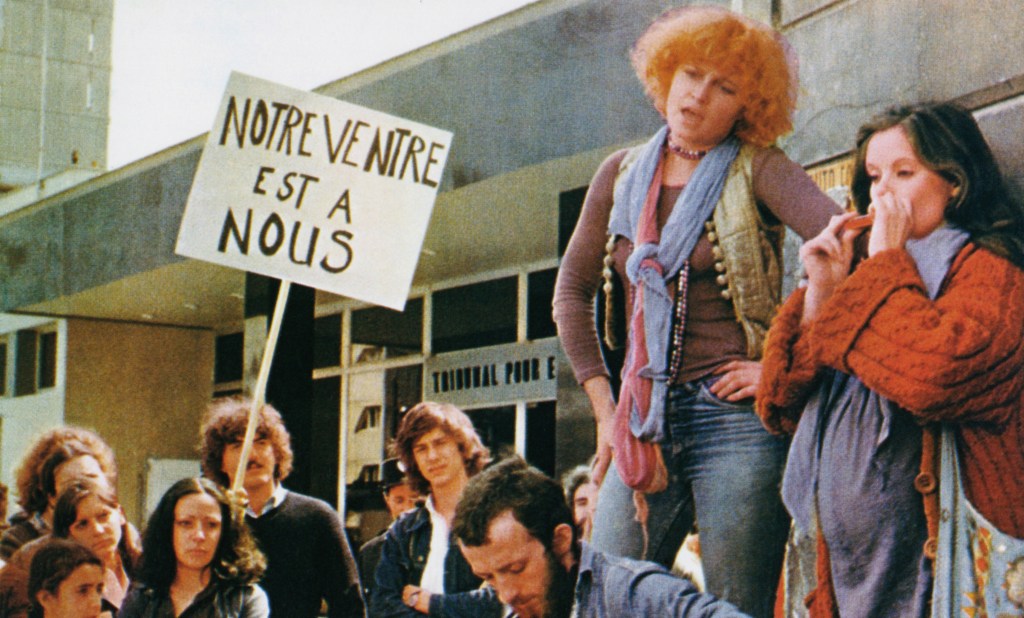
Varda’s story is rough on parents and spouses, enough so that Vincent Canby complained in his New York Timesreview that the picture’s separatist polemics made moot the winning performances and surehanded moviemaking. But Canby’s carping seems sour, even if Varda’s scheme blatantly celebrates women knitting together their own emotional communities, and even if Apple’s earnest songs are wincingly raw and on-the-nose. It’s the ’70s, man; just look at the failed promise of the wilting E.R.A. and the feminist motifs percolating through a number of notable movies this particular year. Varda deliberately assembles women in groups and scrutinizes the nurturing, not depicting it as easy, but plainly asserting that starchy parents and sketchy men often make it necessary.
Apple and Suzanne are drawn to one another initially in solidarity, but swiftly also out of deepening affection. The earthy Mairesse, frizzy hair adorned with beads as she performs on streets, and the delicate, angular brunette Liotard are compellingly warm together, forging an easygoing, radically accepting lifelong friendship that avoids the kind of competitive dramatic baggage that would make flamboyant Oscar bait of The Turning Point later this year. The Turning Point is about narrow spotlights; One Sings embraces an open-hearted communal spirit, and an idea of unconventional family-making that now seems largely mainstream.
Apple’s wan songs (original folky tunes, with lyrics by Varda) seem hokey now, but hardly improbable to their moment. The formidable upside is the ease of Varda’s sweep as the story moves across years and countries; the eye on pre-revolution Iran is particularly fascinating, showing a society far more open back then yet still so gender-segregated that Apple has to scamper back to France, and the bargain she makes with her not-thoroughly-villainous husband (she marries the handsome economist in Iran) is the twist that gives the picture its biggest progressive kick.
Varda’s 1969 hippies-in-Hollywood Lions Love (…and Lies), starring Hair songwriters James Rado and Galt MacDermott with Warhol star Viva, American director Shirley Clarke and Varda herself, was very end-of-the-’60s, and this is quite middle-of-the-’70s. Watch the two together, or twin this with The Turning Point and its much, much more conventionally histrionic female frenemy-ship.
Peppermint Soda (7/15/79 U.S., 12/77 France)
Writer-director Diane Kurys was 30 when this first picture was released in the U.S., and it’s as good an evocation of early teen life at school as you can find on screen. It’s her own story (Alain Le Henry gets co-credit for the screenplay), set in 1963, about her 13 year-old self and her 15 year-old sister, living with their divorced mother in Paris after their father sends them back on the train (he has them for summers).
Kurys has a great eye and ear right from the start, as the hordes of girls swarm and gossip and then form rigid lines as the usual gargoyle figureheads try to impose discipline on what will be a long year. The kids wickedly disrupt class, intuitively abusing the weakest teacher, passing notes and cheating, suffering humiliations from the headmistress, the insulting art teacher, the tubby gym teacher. While these seem like broad types, the essential tension rings true, and Kurys gets splendid performances from the young cast. Eléonore Klarwein is pinched, suspicious and generally disgruntled as 13 year old Anne, anxious because she hasn’t yet gotten her first period, slacking in classes, more interested in trying on pantyhose and sneaking out the café for peppermint sodas. Whenever she can, she eavesdrops on the conversation in the bedroom shared by the mother (a loving-scolding-fretful Anouk Ferjac) and her older sister Frédérique (Odile Michel, confident and bossy as the older sibling). Males are largely but not entirely absent. The father is so hapless that when he takes the girls for a meal, the conversation goes in stunted circles, and while the older sister has a beau (the schoolyard rumors of sex are hilariously wrong), she also has a dicey encounter with the father of a friend who has run away, during which, caught up in the melodrama of it all, she invites, and gets, a nervous kiss.
Lycee Jules-Ferry, with its ample, echoing halls, its huge brick presence, its window views of the Eiffel Tower and its massive courtyard where a memorable rebel yell bounces off the walls, is the richly atmospheric Parisian school where much of this was filmed. It’s the story of a year, peppered with incidents, and the tone is strikingly mature for a first-timer, largely because Kurys takes so seriously the girls’ pensiveness, anxiety, mischief, meanness, and anger. Comparisons have often been made to Truffaut’s The 400 Blows, and that’s not wrong, but this colorful, closely observed semi-autobiographical portrait details a world quite unknown to Antoine Doinel. Watch with the bristly 1968 British boys’ school picture If…

