4.2.26. Pressure Point, Bad Company
Pressure Point (12/2/62)
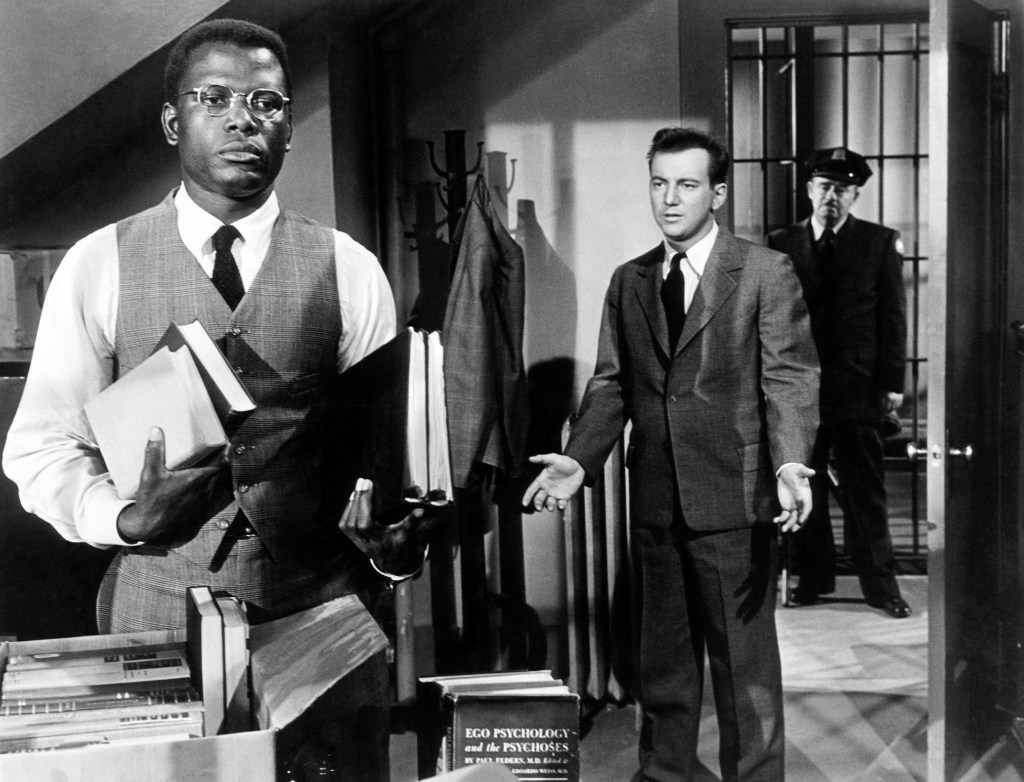
Alarming, with a pensive, studied Sidney Poitier as a psychiatrist treating a racist Nazi inmate played by a wily and blunt Bobby Darin, bursting into view as a crooner and screen actor. (Darin made seven pictures from 1961-63, earning a supporting actor Oscar nomination for Captain Newman, M.D.; in 1962 alone he released three records and four movies.) The film was critiqued for its reductive psychological explanations of Darin’s fury as rebelling against his horrific, abusive, alcoholic, womanizing father, and then against the Jewish man who rejected the impoverished young Darin as not good enough for his daughter. And it’s true that when Darin is climbing the walls with sleeplessness and angst, the movie — produced by topical-minded Stanley Kramer, directed with serious TV-style staginess by Hubert Cornfield — raves a bit.
But that’s not what’s interesting, and durably disconcerting. It turns out that the screenplay, drawn from psychologist Robert Mitchell Lindner’s 1955 book The Fifty-Minute Minute Hour, is as clinical about political movements as it is about individual hangups. During one of the closed-door doctor-patient sessions, with Poitier probing about the anti-Jew, anti-Black fury, Darin’s character is briskly analytical about how his movement will grow, and how power will shift. This, by the way, is all a flashback, with an older Poitier calming down one of his frustrated psychologists, an exploding, seething Peter Falk, by recalling this tough case of his own. So we are in the 1940s here, during the war, examining the stateside pro-Hitler faction. Darin’s character explains it all in textbook fashion, straight out of Richard Hofstadter’s 1964 The Paranoid Style in American Politics and Eric Hoffer’s 1951 The True Believer. Lies — Big Lies — manufacture enemies, stoke grievances, rev up hate, conflict, chaos, and justify boundless fights for power.
“Go ahead and laugh,” the pro-Nazi Darin says to a skeptical Poitier. “Laugh and you’ll never see us coming.”
The proto-fascists, Poitier parries, “will be stopped, because everything you’re driving for is founded on a lie.”
But then the screenplay, credited to Cornfield and S. Lee Pogostin (reported in his Variety obit as a John Cassavetes pal, and the man tapped by Arthur Miller to adapt Miller’s antisemitism novel Focus), is canny enough to show the lie working against the Black man in a small room of “respectable” whites in power. The reversal is quiet, sure, and wildly resonant. Appalling to watch from the vantage point of the post-Obama/Trump Fever years. To max out the psycho-political toxicity, watch with The Manchurian Candidate, released only weeks earlier, and, in the shocked wake of JFK’s assassination, suppressed until the 1980s.
Bad Company (10/20/72)
Tom Sawyer meets Bonnie and Clyde in this jaunty, crafty, just-real-enough outlaw buddy western from Bonnie and Clyde scribes Robert Benton and Thomas Newman, and with Benton launching his well-judged, selective directing career. The team for this 1863-set adolescent adventure is crackerjack: production designer Paul Sylbert (Heaven Can Wait, One Flew Over the Cuckoo’s Nest) and art director Robert Gundlach (Love Story, Eyes of Laura Mars) organizing pre-electricity dark frontier interiors and wide views of empty heartland fields and woods; Anthea Sylbert (Chinatown, Shampoo) cladding the characters in worn, textured fabrics that look deeply lived in while also adding subtle flair (the dusty bowler worn by young Jeff Bridges says tons about his hardwired cocky mischief); a pensive-playful piano score composed and performed by Broadway’s Harvey Schmidt (The Fantasticks, 110 in the Shade); and — you know this at a glance — cinematography by Gordon Willis, following his work on Klute and The Godfather and continuing to forge a signature 1970s cinematic look as he captures faces in near-black rooms and frames groups in telling settings.
Just behold the long early tracking shot when our young hero (played with bedrock civility and just a touch of gumption by Barry Brown), fresh from narrowly eluding Union troop conscription and lovingly sent off into the world by his co-conspirator mother and father, arrives in St. Joseph, Missouri and surveys the long line waiting for a wagon train … only two find two Union soldiers eying him when he gets to the end. Brown nervously moves down the street, camera still tracking, until Bridges pops at him from an alley and begins his jive talk, wheedling info out of the naïve kid and luring him into another alley to mug him. That mid-shot pause on the soldiers is jarring after the optimistic feeling of hitting town, but also kind of funny, and certainly suspenseful. And the long shot will have more to say, catapulting our protagonist into the picture’s key relationship, and defining it right away in all its complexity. It’s an artful unspooling of info.
This will be the Benton mode: easy artistry, understated tone, brassy characters, assertive storytelling.
Brown’s character occasionally narrates, his experience is our point of view, but Bridges’s upbeat, swaggering character works his way to the center of every situation. Bridges, comfortably carrying a picture for the first time as he follows up on The Last Picture Show and Fat City, is the Tom Sawyer spirit, eager for action, blustering his way into commanding a ragtag band of urchins camping rough and slinking into town for the odd robbery. One thing leads to another, and after Brown and Bridges bump into each other again and brawl (it’s a good fight in a preacher’s house), Brown joins the gang. Escapades ensue, and the tale becomes an origin story of sorts as this odd couple become buddies and antagonists and gradually ease into their own version of, as mentioned, Bonnie and Clyde.
You can find claims for this as an “acid western,” a loose, quasi-trippy classification that typically includes midnight-friendly flicks like Monte Hellman’s 1966 The Shooting and Dennis Hopper’s 1971 The Last Movie, but this seems to have too much calculated (in a good way) literary/cinematic cool for that handle to fully apply. Newman and Benton have a great feel for dialogue, and the only time this gets nearly too precious is with the foul-mouthed, cigarette-smoking, liquor-swilling 10-year old who styles himself as the toughest member of the gang. The young outlaws bicker with flair, but it’s never over-written, and the script’s nose for offbeat incidents includes a prairie scene with a man pimping his wife to the lads. That’s right on the edge of tastelessness, but the writing is sly and the acting is wily, including Monika Henreid’s businesslike, quietly bumptious turn as the wife, and, elsewhere, with commanding character actor David Huddleston as a fur-wearing, sharpshooting outlaw, and with John Savage as a suspicious, serious foil for Bridges in the gang. For all 93 minutes, this picture knows what it’s doing.
Classy, entertaining double features can be made all kinds of ways: with Bonnie and Clyde; with any Benton-directed picture (ideally The Late Show or Places in the Heart); with other twisted Westerns of the moment like McCabe and Mrs. Miller or Pat Garrett and Billy the Kid; with Terrence Malick’s picturesque tone poems Badlands or Days of Heaven; with Willis’s ultra-composed western work for director Alan Pakula’s Comes a Horseman; with Bridges goofing alongside a squinting Clint Eastwood in Thunderbolt and Lightfoot or striving alongside carefree Sam Waterston in Rancho Deluxe …
 Nelson Pressley