Likely, through summer 2026, to be a post every week or so excerpted from Last Details & Parallax Views (working title), a notebook on 1960s-70s movies. Stay tuned…
3.30.26: A note on the ongoing Fonda
Because she does, right?
Jane Fonda’s weekend was a typical whirl. Friday, 3/27, she made news at a rally outside the Kennedy Center (my heartbreak is boundless over the Dark Ages invasion at the vaunted performing arts space and presidential memorial, where I spent innumerable days/evenings across my years in D.C.), warning of authoritarianism, championing the arts, keeping visible the newly-revived Hollywood activist Committee of the First Amendment. By Saturday, Fonda was in Minnesota, front and center at St. Paul’s flagship No Kings protest, with Springsteen, Bernie Sanders, and thousands in the streets — millions nationwide — raising their voices.
Oh, and a week or so earlier, pre-production was announced on a movie version of Virginia Evans’s 2024 bestselling book, The Correspondent, with Fonda to star. Gigs & gossip (is she feuding with Streisand over the Redford tribute at the Oscars?), glam & gritty. She gets up and does it again. Amen.
She’s 88. She’s been like this for decades.
“I’m so glad to be alive right now,” Fonda told Jen Psaki on MS Now, the day before the No Kings event. Fonda’s exhortation was rousing: Get in there! Make a difference! This is the moment!
I snapped the photo below as I finally embarked full-time on a book project I’d noodled with for years, now available as Fonda on Film: The Political Movies of Jane Fonda. I’d had no idea that she was about to set up shop in D.C. throughout the autumn of 2019, donning a blazing red coat and leading Fire Drill Fridays rallies on Capitol Hill and hosting Thursday night “teach-ins” on Facebook. Couldn’t be surprised, though. Of course that period became a chapter in my book. And of course she wrote her own book, the 2020 What Can I Do? My Path from Climate Despair to Action.
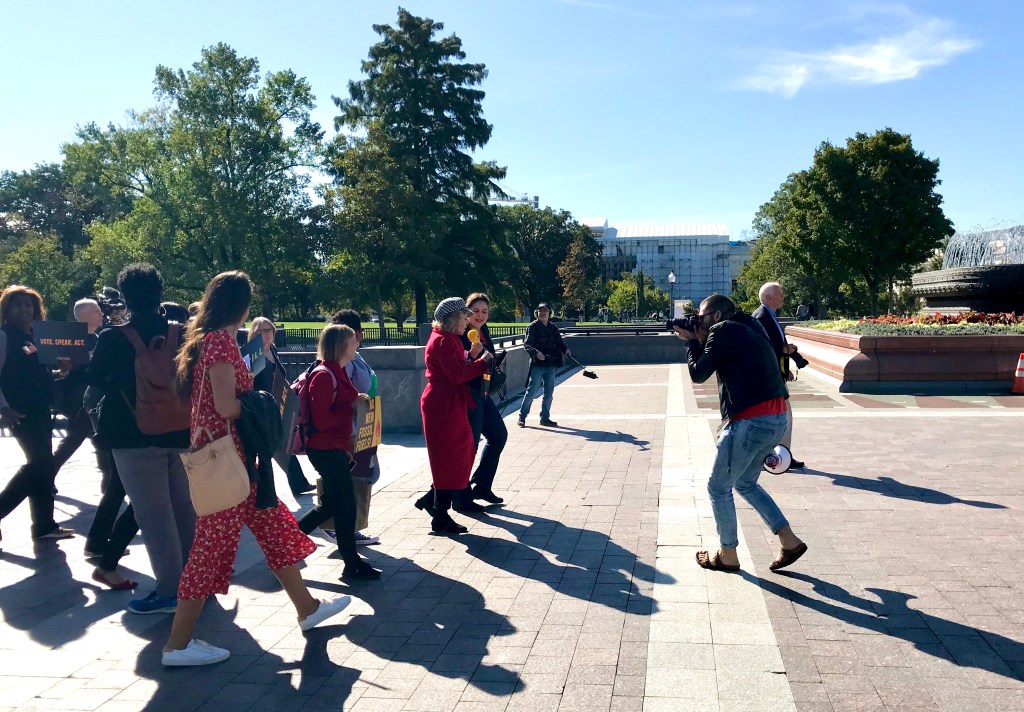
She will keep it up. No need for this space to keep tabs on her; if you’re interested, you can set up a daily Jane Fonda news alert. I’ve had one for years.
4.2.26: Two ’60s flicks and a book
Pressure Point (12/2/62)
Alarming, with a pensive, studied Sidney Poitier as a psychiatrist treating a racist Nazi inmate played by a wily and blunt Bobby Darin, bursting into view as a crooner and screen actor. (Darin made seven pictures from 1961-63, earning a supporting actor Oscar nomination for Captain Newman, M.D.; in 1962 alone he released three records and four movies.) The film was critiqued for its reductive psychological explanations of Darin’s fury as rebelling against his horrific, abusive, alcoholic, womanizing father, and then against the Jewish man who rejected the impoverished young Darin as not good enough for his daughter. And it’s true that when Darin is climbing the walls with sleeplessness and angst, the movie — produced by topical-minded Stanley Kramer, directed with serious TV-style staginess by Hubert Cornfield — raves a bit.
But that’s not what’s interesting, and durably disconcerting. It turns out that the screenplay, drawn from psychologist Robert Mitchell Lindner’s 1955 book The Fifty-Minute Minute Hour, is as clinical about political movements as it is about individual hangups. During one of the closed-door doctor-patient sessions, with Poitier probing about the anti-Jew, anti-Black fury, Darin’s character is briskly analytical about how his movement will grow, and how power will shift. This, by the way, is all a flashback, with an older Poitier calming down one of his frustrated psychologists, an exploding, seething Peter Falk, by recalling this tough case of his own. So we are in the 1940s here, during the war, examining the stateside pro-Hitler faction. Darin’s character explains it all in textbook fashion, straight out of Richard Hofstadter’s 1964 The Paranoid Style in American Politics and Eric Hoffer’s 1951 The True Believer. Lies — Big Lies — manufacture enemies, stoke grievances, rev up hate, conflict, chaos, and justify boundless fights for power.
“Go ahead and laugh,” the pro-Nazi Darin says to a skeptical Poitier. “Laugh and you’ll never see us coming.”
The proto-fascists, Poitier parries, “will be stopped, because everything you’re driving for is founded on a lie.”
But then the screenplay, credited to Cornfield and S. Lee Pogostin (reported in his Variety obit as a John Cassavetes pal, and the man tapped by Arthur Miller to adapt Miller’s antisemitism novel Focus), is canny enough to show the lie working against the Black man in a small room of “respectable” whites in power. The reversal is quiet, sure, and wildly resonant. Appalling to watch from the vantage point of the post-Obama/Trump Fever years. To max out the psycho-political toxicity, watch with The Manchurian Candidate, released only weeks earlier, and, in the shocked wake of JFK’s assassination, suppressed until the 1980s.
Bad Company (10/20/72)
Tom Sawyer meets Bonnie and Clyde in this jaunty, crafty, just-real-enough outlaw buddy western from Bonnie and Clyde scribes Robert Benton and Thomas Newman, and with Benton launching his well-judged, selective directing career. The team for this 1863-set adolescent adventure is crackerjack: production designer Paul Sylbert (Heaven Can Wait, One Flew Over the Cuckoo’s Nest) and art director Robert Gundlach (Love Story, Eyes of Laura Mars) organizing pre-electricity dark frontier interiors and wide views of empty heartland fields and woods; Anthea Sylbert (Chinatown, Shampoo) cladding the characters in worn, textured fabrics that look deeply lived in while also adding subtle flair (the dusty bowler worn by young Jeff Bridges says tons about his hardwired cocky mischief); a pensive-playful piano score composed and performed by Broadway’s Harvey Schmidt (The Fantasticks, 110 in the Shade); and — you know this at a glance — cinematography by Gordon Willis, following his work on Klute and The Godfather and continuing to forge a signature 1970s cinematic look as he captures faces in near-black rooms and frames groups in telling settings.
Just behold the long early tracking shot when our young hero (played with bedrock civility and just a touch of gumption by Barry Brown), fresh from narrowly eluding Union troop conscription and lovingly sent off into the world by his co-conspirator mother and father, arrives in St. Joseph, Missouri and surveys the long line waiting for a wagon train … only two find two Union soldiers eying him when he gets to the end. Brown nervously moves down the street, camera still tracking, until Bridges pops at him from an alley and begins his jive talk, wheedling info out of the naïve kid and luring him into another alley to mug him. That mid-shot pause on the soldiers is jarring after the optimistic feeling of hitting town, but also kind of funny, and certainly suspenseful. And the long shot will have more to say, catapulting our protagonist into the picture’s key relationship, and defining it right away in all its complexity. It’s an artful unspooling of info.
This will be the Benton mode: easy artistry, understated tone, brassy characters, assertive storytelling.
Brown’s character occasionally narrates, his experience is our point of view, but Bridges’s upbeat, swaggering character works his way to the center of every situation. Bridges, comfortably carrying a picture for the first time as he follows up on The Last Picture Show and Fat City, is the Tom Sawyer spirit, eager for action, blustering his way into commanding a ragtag band of urchins camping rough and slinking into town for the odd robbery. One thing leads to another, and after Brown and Bridges bump into each other again and brawl (it’s a good fight in a preacher’s house), Brown joins the gang. Escapades ensue, and the tale becomes an origin story of sorts as this odd couple become buddies and antagonists and gradually ease into their own version of, as mentioned, Bonnie and Clyde.
You can find claims for this as an “acid western,” a loose, quasi-trippy classification that typically includes midnight-friendly flicks like Monte Hellman’s 1966 The Shooting and Dennis Hopper’s 1971 The Last Movie, but this seems to have too much calculated (in a good way) literary/cinematic cool for that handle to fully apply. Newman and Benton have a great feel for dialogue, and the only time this gets nearly too precious is with the foul-mouthed, cigarette-smoking, liquor-swilling 10-year old who styles himself as the toughest member of the gang. The young outlaws bicker with flair, but it’s never over-written, and the script’s nose for offbeat incidents includes a prairie scene with a man pimping his wife to the lads. That’s right on the edge of tastelessness, but the writing is sly and the acting is wily, including Monika Henreid’s businesslike, quietly bumptious turn as the wife, and, elsewhere, with commanding character actor David Huddleston as a fur-wearing, sharpshooting outlaw, and with John Savage as a suspicious, serious foil for Bridges in the gang. For all 93 minutes, this picture knows what it’s doing.
Classy, entertaining double features can be made all kinds of ways: with Bonnie and Clyde; with any Benton-directed picture (ideally The Late Show or Places in the Heart); with other twisted Westerns of the moment like McCabe and Mrs. Miller or Pat Garrett and Billy the Kid; with Terrence Malick’s picturesque tone poems Badlands or Days of Heaven; with Willis’s ultra-composed western work for director Alan Pakula’s Comes a Horseman; with Bridges goofing alongside a squinting Clint Eastwood in Thunderbolt and Lightfoot or striving alongside carefree Sam Waterston in Rancho Deluxe …
Book Break
The Accidental Feminist: How Elizabeth Taylor Raised Our Consciousness and We Were Too Distracted By Her Beauty to Notice, M.G. Lord (2012)
Prolix title notwithstanding, this is a compact, focused appreciation of Taylor’s political impact, from triumphing as the young equestrian in the 1944 National Velvet (Taylor was 12) to taking a skittish America by the hand starting in the 1980s in the fight against AIDS. Did Taylor grasp the feminist messages of A Place in the Sun, Suddenly, Last Summer, Butterfield 8? Probably not, Lord is told by Kate Burton, Richard Burton’s daughter before his marriages to Liz. Kate Burton reckons that Taylor was simply being Taylor — defiant and independent, qualities that feminism championed.
Taylor embodied feminism even as the movement and its language was forming; Lord swiftly invokes Virginia Woolf’s 1938 Three Guineas and Betty Friedan’s 1961 The Feminine Mystique, establishing thinking and principles that were in the air as Taylor wielded her uncommon blend of beauty and empathy on the screen. Pivotal to Lord is the Place in the Sun moment when Taylor, the gorgeous patrician object of the working-class hero’s desire, murmurs, “Tell mama. Tell mama all,” a loving, primitive invitation that reduces Montgomery Clift, and us, to slack-jawed slobs.
It’s a rare screen power, and Lord is fascinated by how Taylor wielded it. Taylor was progressivism itself as the antiracist matriarch of Giant, became the stiff resistance to the lobotomy cruelty prescribed to “hysterical” women in Tennessee Williams’s Suddenly, Last Summer (Williams’s sister Rose, of course, had been subjected to the process), was “body-positive” in Butterfield 8 (and punished for it, of course) before the phrase had meaning, and — returning to the stage after dropping movies to be Senator John Warner’s wife in the late 1970s — pissed off playwright Lillian Hellman when she triumphed in Pendleton’s pointedly feminist Little Foxes on stage in Washington, New York, L.A. and London. The Sandpiper, Taylor’s 1965 standoff with Richard Burton as she played an independent single mother against his parochial school head where a court orders the boy to get his schooling, gets a lot of flack as drippy hooey, but Lord loves it (rightly) and breaks it down sharply from the opening images.
She skips what doesn’t serve, and of course not everything does. Lord argues that the bloated 1961 Cleopatra failed Taylor, then titanically famous and increasingly crafty on screen, in script and setting, and after Edward Albee’s rip-roaring 1966 Who’s Afraid of Virginia Woolf? with Burton, the book explores only the 1973 Ash Wednesday, with its theme of aging and its jarring opening face-lift scene. Lord, a reporter, the author of the 1994 Forever Barbie: The Unauthorized Biography of a Real Doll and a USC professor, did the sort of legwork that would normally generate a biography, and while she sparingly relates insights shared with her by Suddenly, Last Summer adapter Gore Vidal, The Little Foxes stage director Austin Pendleton, gossip columnist Liz Smith and more, the project’s value lies in the socially contextualized movie analyses. Accidental Feminist is small, and it’s a short 171 pages, but it’s effective. Even if you’re already partial to this sort of view of Taylor, Lord affixes your framing to an angle that sticks.
 Nelson Pressley